


Jefferson and the Wall of Separation Between Church and State
- Brandyn M
- Oct 9, 2021
- 3 min read

Updated: Jul 6, 2023
Michael A. Smith
revised July 5, 2023
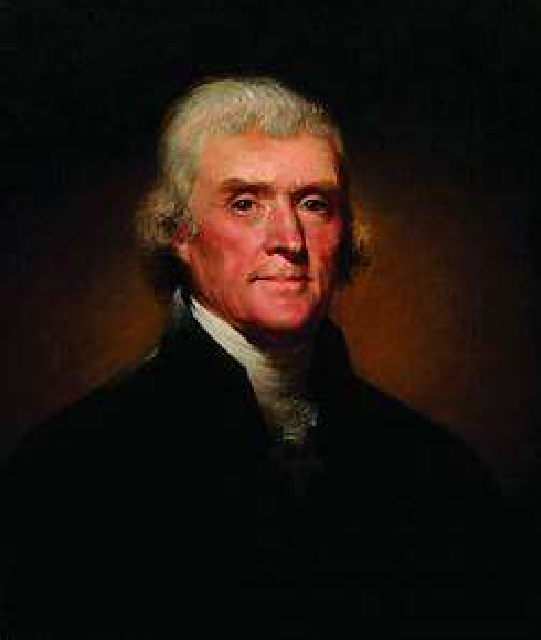
Thomas Jefferson, who if you measured him by today’s religious standards, was the most irreligious of our Founding Fathers, and yet he wrote and thought more about religion than any of his colleagues. One of Jefferson's most notable writings is his response to the Danbury Baptists regarding the separation of church and state. In this letter, he employs the metaphorical phrase "a wall of separation" to describe the First Amendment of the Constitution, which has become the established doctrine on this matter. Interestingly, the phrase fell out of public use until it was revived in the Supreme Court case Everson v. Board of Education in 1947, sparking debates about Jefferson's original intention and current interpretation. As is often the case with significant terms, the intended meaning can be discerned by consulting the dictionary employed by the writer. Therefore, a careful examination of Jefferson's initial remarks and the historical context of the phrase raises intriguing questions about the ongoing controversy surrounding its meaning.
Jefferson's response to the Danbury Baptists, occasioned by their desire to congratulate him on his recent inauguration and their wish for him to express his views on the issue of church-state separation publicly, also provided him with an opportunity to address his critics regarding his refusal to issue proclamations for days of fasting and thanksgiving, as his predecessors had done. The battle over establishing a state-sponsored church was still raging in 1801, with the Federalists criticizing Jefferson's lack of action. Thus, a clear statement was needed to address the matter definitively. The Danbury Baptists and others emerged as staunch defenders of Jefferson's views. His response encompassed key points that eventually became the prevailing doctrine of the American government, at least until recently.
As astutely summarized by Daniel Dresbach, the central question among Baptists revolved around whether the free expression of religion was an inherent right guaranteed by the Constitution or merely a granted privilege. Jefferson affirmed his belief that no individual should face repercussions due to religious beliefs. In his papers, revisions to the letter accompanied by marginal notes and a final draft indicate the meticulousness with which he expressed his position.
By examining both the preliminary versions and the final letter, it becomes evident that Jefferson was fully aware of the political impact his words would have on the ongoing debate with the Federalists, who sought to portray him as anti-religious. It provided him with an opportunity to explain his reluctance to proclaim days of religious observance. Jefferson's religious views had been debated during his election, with various newspapers branding him as an infidel.
The care with which Jefferson approached his letter suggests that he may have anticipated that his ideas were only sometimes accepted at the time. Nonetheless, he believed his thoughts held formative value, as evidenced by submitting the text to his attorney general for review. Levi Lincoln, the attorney general, expressed caution due to concerns about further attacks from the Federalists of New England. Jefferson sought counsel from various sources, and the feedback he received informed the revision of the letter into its final form.
In conclusion, President Jefferson concurred with the Danbury Baptists that religious matters were best left to the discretion of the individual and God, with the government having no right to impede the free exercise of religion in America. The metaphorical "wall of separation" between government and religion became a distinct expression to signify government actions and religious involvement in governance until recently. However, Jefferson's wall has been challenged in the last two decades. Like so many issues today, we seem to want to break things that work to excuse our desires to “know better” than our forebearers.

BIBLIOGRAPHY:
1 Jefferson, Thomas, and Henry Augustine Washington. The writings of Thomas Jefferson: being his autobiography, correspondence, reports, messages, addresses, and other writings, official and private. Vol. 8. Washington, D.C: Taylor & Maury, 1853-1854. Sabin Americana: History of the Americas, 1500-1926 (accessed September 7, 2021). https://link.gale.com/apps/doc/CY0105513661/SABN?u=vic_liberty&sid=bookmarkSABN&xid=432698dc&pg=120.
2The Papers of Thomas Jefferson, Volume 35: 1 August to 30 November 1801 (Princeton University Press, 2008), 407-9.
3Letter from Thomas Jefferson to Levi Lincoln, 1 January 1802, The Papers of Thomas Jefferson (Manuscript Division, Library of Congress), Series 1, Box 89, 2 December 1801-1 January 1802; Presidential Papers Microfilm, Thomas Jefferson Papers (Manuscript Division, Library of Congress), Series 1, Reel 25, 15 November 1802-31 March 1802.
4 Daniel Driesbach, Thomas Jefferson and the Wall of Separation Between Church and State (New York University Press, 2002, 461. 5Ibid.


Comments